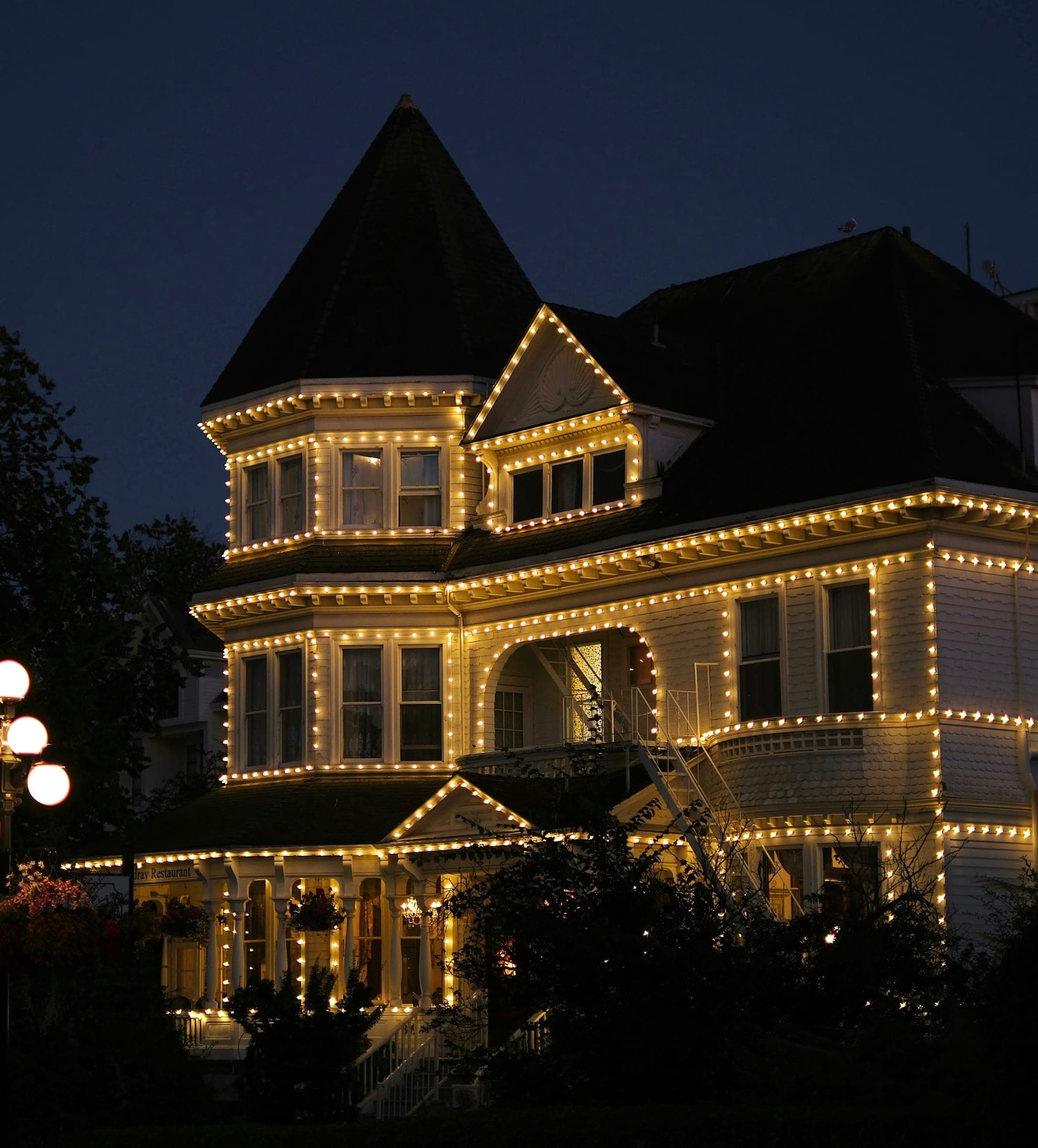
Most Christmas light advice is written for snow and ice. South Florida has a different problem: water. Our holiday season brings passing showers, heavy dew most nights, humidity that never quite leaves, and — anywhere near the coast — salt in the air. None of that freezes, but all of it finds its way into connections.
Here's how to keep an outdoor display working from install day to January.
Why water is the real enemy here
The lights themselves are rarely the problem. Outdoor-rated strands are built to get wet. The weak points are the places where two things connect:
- Plug-to-plug connections between strands and extension cords.
- The outlet itself, especially if its cover doesn't close with a cord plugged in.
- Sockets on C9 strands, if a bulb isn't seated all the way.
When water bridges a connection, a ground-fault (GFCI) outlet does exactly what it's designed to do: it cuts the power. That's why so many Miami displays go dark after a shower and come back the next afternoon once things dry out.
Keep connections off the ground
The single most useful habit: never let a connection sit on the ground or in a gutter. Lawns here stay wet, sprinklers run at night, and gutters hold water.
- Lift plug connections onto something — a stake, a hook, the wall.
- Point connections downward where you can, so water runs off instead of in.
- Leave a small drip loop — a little dip in the cord just before it reaches the outlet — so water drips off the bottom of the loop instead of running into the plug.
Use the right outlets and cords
- Plug only into outdoor outlets with GFCI protection, with an in-use cover (the bubble-style cover that closes over a plugged-in cord).
- Use outdoor-rated extension cords only, and as few as you can.
- Don't chain too many strands end to end. Check the strand's label for its maximum.
If an outlet trips repeatedly even when everything is dry, have it checked. Don't swap it for a non-GFCI outlet or plug into an indoor outlet through a window — that protection is there for a reason.
Humidity and storage
Humidity matters most when the lights are not up. A strand that spends eleven months in a hot garage can corrode at the sockets and plugs, and come out in November with dead sections. If you store your own lights, keep them somewhere climate-controlled and dry, in sealed bins. Our takedown and storage guide has more on this.
Salt air near the coast
On Key Biscayne, Miami Beach and other homes close to the water, salt speeds up corrosion on metal contacts. Commercial-grade strands and keeping connections sheltered help a lot. So does not reusing store-bought strands for too many seasons.
Storms and wind
December is past hurricane season, but strong cold fronts still bring gusty wind. Lights that are clipped every foot along the roofline stay put; lights that are draped or tied loosely flap and pull at their connections. Palm wraps should be tight enough that fronds and wind don't loosen them.
Commercial-grade vs. store-bought
Store-bought strands can work fine for a season. Commercial-grade strands are built heavier, with tighter sockets and sturdier wire, and they handle repeated wet nights better. It's one reason professional displays tend to stay lit through a South Florida season. Our C9 vs. mini lights guide covers the difference in more detail.
If you'd rather not think about it
With us, the weather is our problem. We install commercial-grade LED lights, plan your power and outdoor outlets with you at your design visit or call, set up a dusk-to-dawn timer, and if anything goes dark — after a storm or for any other reason — we fix it within 48 hours, free, all season. In January we take it all down, so nothing sits in your garage.
Get your instant quote to see what your home would cost, in about two minutes.
Rather skip the homework?
See your price in about two minutes
Tell us what you'd like lit and the quote shows your all-in seasonal price right away — design, commercial-grade lights, installation, maintenance and January takedown included.