Putting up your own Christmas lights is a South Florida tradition for a lot of families. If you're planning to do it yourself this year, this guide walks through the whole job — what to buy, each step in order, how to stay safe on a ladder, and how long each part realistically takes, so you can plan your weekends before you start.
The time estimates below are for a first-time do-it-yourselfer working with one helper. Experienced decorators will be faster; homes with tall palms, two stories or a tile roof will take longer.
Before you start: decide what you're decorating
Walk around the house and write down what you want lit. It's the list everything else depends on:
- Rooflines — which sides of the house (front only, or front and sides), and whether it's one story or two.
- Palms and trees — how many, and how tall. Anything you can't reach from a step ladder is a different job.
- Bushes and hedges — how many bushes, and roughly how long each hedge is.
- The entry — a wreath, garland around the door.
- Pathway — the length of the walk from the driveway to the door.
Time: about 30 minutes.
Step 1: Measure and plan
Measure each roofline section you'll light, the height of each palm trunk, and the length of the pathway. Then find your power: note every outdoor outlet, whether it has ground-fault (GFCI) protection, and how far it is from each thing you'll light. Sketch where each strand will start and end and which outlet feeds it — running a cord across the driveway is the most common surprise on install day.
Check your HOA's decorating rules now, too. Many Miami-area communities have them, and it's easier to plan around them than to take lights down later.
Time: 1 to 2 hours.
Step 2: Shop for materials
Most of what you need is at any home-improvement store:
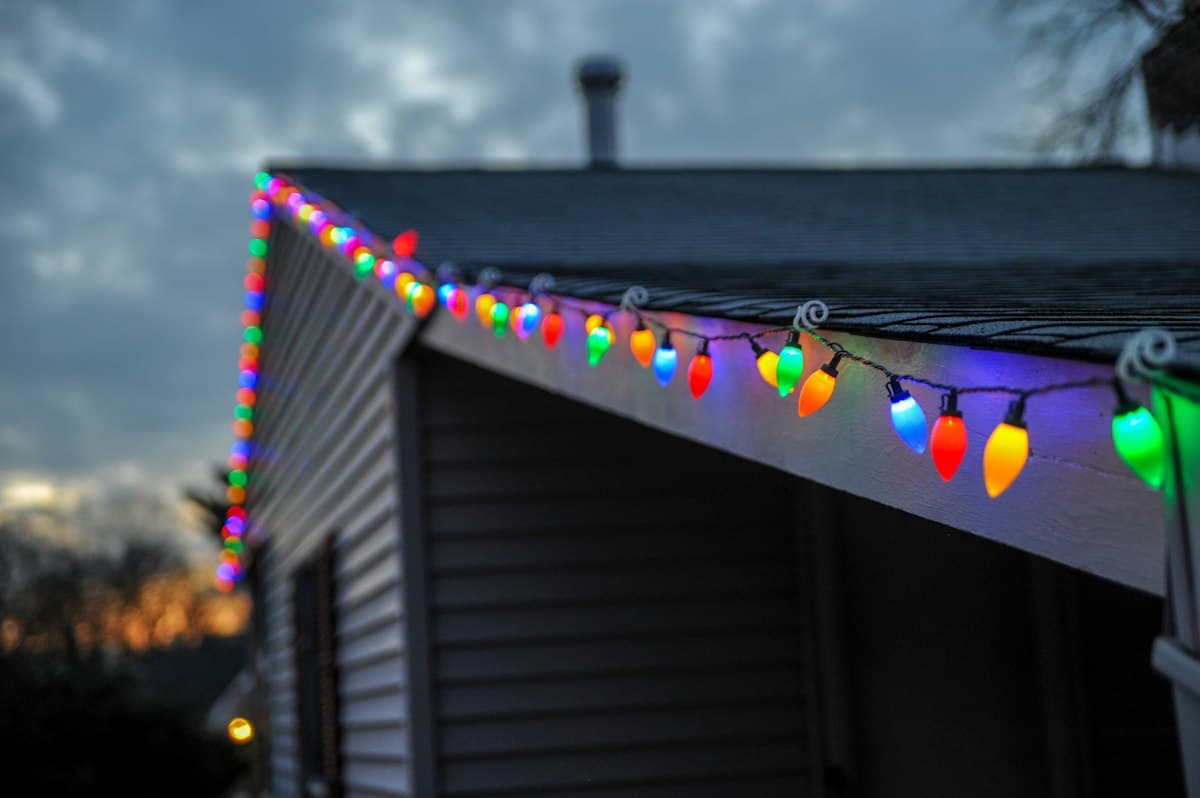
- Light strings. Pick one style per area — larger bulbs for rooflines, mini lights for palms, trees and bushes — and buy the same color and brand for each area so the whites match. Buy about 10% more than your measurements; strands come in fixed lengths.
- Clips. All-in-one clips for gutters and shingles. If you have a barrel or flat tile roof, check that the clips actually fit your tile edge before buying in bulk — many don't.
- Outdoor-rated extension cords in the lengths your sketch calls for, plus a few extra.
- An outdoor timer or smart plug for each outlet you'll use.
- Stakes for pathway lights, and zip ties or green tape for palms and railings.
- A ladder rated for the job. A step ladder for one-story eaves; for anything higher, an extension ladder long enough to extend about three feet past the edge you're working on.
- Gloves, and a helper to hold the ladder and pass up lights.
Expect more than one trip — matching quantities of the same strand are often sold out by late November.
Time: 2 to 4 hours, including at least one return trip.
Step 3: Test everything on the ground
Plug in every strand before it goes anywhere near a ladder. Replace dead bulbs and blown fuses now, and set aside any strand that flickers. Lights that sat in a hot Miami garage all year are the usual culprits.
Time: 1 to 2 hours in year one — often longer in later years, after storage.
Step 4: The roofline
This is the biggest part of the job and the riskiest.
- Clip first, lights second. Many people attach the clips along the whole edge, then come back and snap the bulbs in — it means fewer reaches per ladder position.
- Space clips about 12 inches apart so the line stays straight and doesn't sag.
- Move the ladder every few feet. Never lean out to reach farther. If you have to stretch, climb down and move it.
- Plan the run so it ends near an outlet, with the plug end hanging where the cord can reach it.
On a tile roof, work from the ladder rather than walking on the tiles — tiles crack underfoot and are slippery, especially with morning dew.
On a two-story home, the roofline is a full extension-ladder job. This is the point where many homeowners decide to hire it out (more on that below).
Time per side of the house: about 1½ to 3 hours on a one-story home, 3 to 5 hours on a two-story home.
Step 5: Palms and trees
Wrapped palm trunks are the signature South Florida look. Start at the base and spiral up with even spacing — keep the spacing consistent or the wrap looks uneven at night. Secure the top and bottom with zip ties so wind doesn't unravel it.
Time: 30 to 60 minutes per palm you can reach from the ground or a step ladder. Taller palms need an extension ladder against a curved trunk, which is genuinely dangerous; plan 1½ to 3 hours each if you attempt them, or leave them unlit.
Step 6: Bushes and hedges
Drape mini-light nets or strands evenly over each bush, tucking the cords underneath. For hedges, run strands along the top and front face.
Time: 15 to 30 minutes per bush, 30 to 60 minutes per hedge.
Step 7: Pathway and entry
Push the pathway stakes in at even intervals and connect them in one run. Hang the wreath with a door hook or adhesive hook rated for its weight, and secure garland around the door frame without nailing into the frame.
Time: 30 to 60 minutes for the pathway, 30 to 60 minutes for the entry.
Step 8: Power, cords and the timer
- Plug everything into GFCI-protected outdoor outlets.
- Keep every connection off the ground and out of places where water collects — our afternoon storms will find them.
- Don't daisy-chain more strands than the package allows.
- Set the timer so the display turns on at dusk and off at bedtime.
- Tuck and secure cords along walls and beds so nobody trips on them.
Time: 1 to 2 hours.
During the season
Expect at least one section to go dark — a loose bulb, a tripped outlet after a storm, a cord a landscaper caught. Each fix means troubleshooting and, often, a ladder again.
Time: 1 to 3 hours across the season.
In January: take it all down
Takedown is faster than installation but not by as much as you'd hope: every clip comes off by hand, from the same ladder positions. Then wind each strand carefully (tangles now mean tangles next November) and pack everything somewhere cool and dry.
Time: about half to two-thirds of your installation time, plus 1 to 2 hours to pack and store.
A word on safety
The U.S. Consumer Product Safety Commission estimates that about 14,900 people were treated in emergency rooms for holiday decorating injuries in a recent season — about 160 a day, with nearly half involving falls (CPSC).
If you do the work yourself:
- Set ladders on firm, level ground — not on mulch, wet grass or a sloped driveway.
- Keep three points of contact and your belt buckle between the rails. Never stand on the top steps.
- Have a helper holding the ladder at all times.
- Don't work on the roof itself, especially tile.
- Stop when it rains or the wind picks up, and skip the ladder work after dark.
Adding it up
Here's how those estimates add up for two typical Miami homes:
- One-story home — front roofline, two palms, four bushes, the pathway and a wreath: about 15 to 22 hours to install, plus 6 to 10 hours for fixes and January takedown. That's roughly three to four full weekend days.
- Two-story home — rooflines on all four sides, four palms (two of them tall), eight bushes, a hedge, the pathway and the entry: about 35 to 50 hours to install, plus 15 to 25 hours for fixes and takedown — the better part of six to eight weekend days, much of it on an extension ladder.
If those numbers fit your plans and you enjoy the work, you now have everything you need. Have fun with it.
Or let Miami Premier Lighting do it
If you'd rather spend those weekends on something else, here's what the same project looks like when we handle it:
- You tell us what you'd like lit. Our instant quote takes about two minutes.
- We design it. We plan the layout from satellite imagery and show you a mockup at a free design visit before anything goes up — no measuring, sketching or shopping.
- We supply everything. Commercial-grade lights and the right clips for your roof, tile included. Nothing to buy, test or match.
- Our insured crew installs it. Rooflines, tall palms and two-story homes included — nobody in your family goes up a ladder.
- We maintain it all season. If a section goes out, we come fix it.
- We take it down in January and take everything with us. Nothing to wind, pack or store.
What you get back is the time: the hours above, the trips to the store and the ladder work — spent with your family instead.
Still deciding? Our honest DIY vs. professional comparison covers when each makes sense, and the free Miami Christmas Lights Planner walks through costs, design ideas and what to ask any installer.